
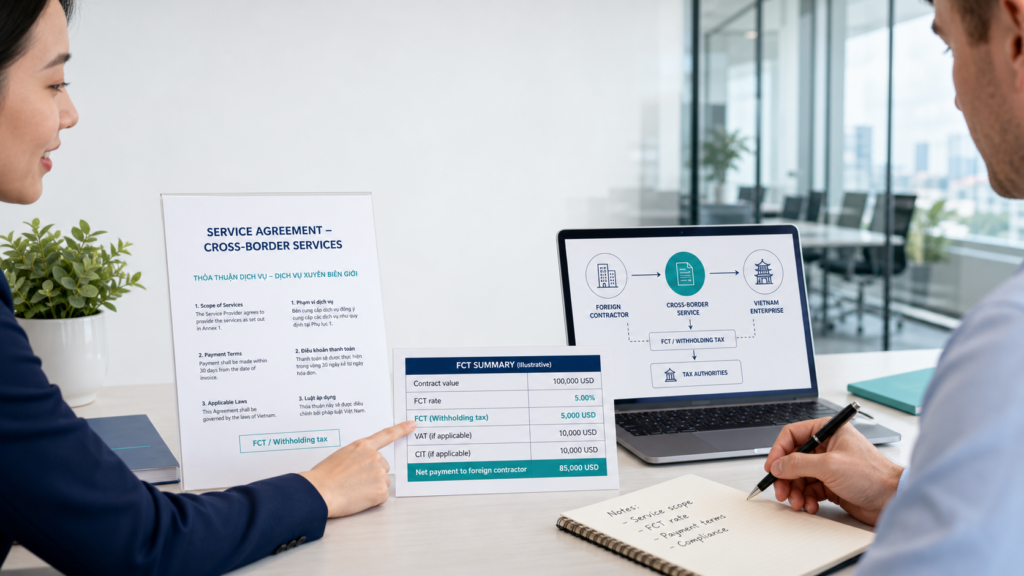
Foreign companies supplying goods, services, or earning income in Vietnam are subject to Vietnam foreign contractor tax (FCT) — even without establishing a local legal entity. The corporate income tax (CIT) component of FCT is calculated as a percentage of gross taxable revenue rather than on net profit, making the effective rate deceptively straightforward but the classification of income critically important.
This guide covers the FCT CIT rules in full under the updated 2025–2026 legal framework: Law No. 67/2025/QH15 (effective 1 October 2025), Decree 320/2025/NĐ-CP (effective 15 December 2025), and Circular 20/2026/TT-BTC (effective 12 March 2026, applying from the 2025 tax year). A key change from 12 March 2026: the hybrid method under Circular 103/2014 has been abolished for new contracts. Only the deemed revenue percentage method now applies.
|
% of Revenue Only tax method from 12/3/2026 |
0.1% – 10% FCT CIT rate range |
12 Mar 2026 Hybrid method abolished |
Vietnamese payer Withholds and remits on behalf |
1. Who is subject to Vietnam foreign contractor tax?
Under Article 2 of Decree 320/2025 and Article 7 of Circular 20/2026, the FCT CIT rules apply to the following categories of foreign enterprises:
| Entity type | Trigger for FCT CIT liability |
|---|---|
| Foreign enterprise with a PE in Vietnam | Conducting business in Vietnam or earning Vietnam-sourced income under a contract, agreement, or commitment with a Vietnamese organisation or individual, or with a foreign sub-contractor |
| Foreign enterprise WITHOUT a PE in Vietnam | Providing services, goods, loans, or royalties to Vietnamese organisations/individuals or to foreign organisations/individuals operating in Vietnam — regardless of where the business is conducted |
| Foreign sub-contractor | Receiving a portion of work from a foreign main contractor to be performed in Vietnam under a sub-contract |
| Foreign e-commerce / digital platform business | Providing goods or services in Vietnam via e-commerce or digital platform activities — even without a physical presence in Vietnam. An e-commerce or digital platform itself constitutes a permanent establishment under Article 2(3)(e) of Decree 320 |
Who withholds and remits FCT CIT?
Under Article 2(2) of Decree 320, the following Vietnamese entities are designated as the withholding party (người nộp thuế thay — tax payer on behalf):
- The Vietnamese party that signs the contract with and pays the foreign contractor
- E-commerce marketplace operators and digital platform managers
- Where the transferee of a capital interest is a foreign organisation or individual: the Vietnamese-incorporated enterprise in which the foreign parties hold their investment
2. FCT CIT exemptions — 13 categories of non-taxable transactions
Article 7(2) of Circular 20/2026 lists the transactions that do not give rise to FCT CIT liability. Understanding these exemptions is essential for accurate contract structuring:
| Exemption category | Conditions |
|---|---|
| Goods supply — delivery at foreign port/border | Seller bears all responsibility, costs, and risk to the foreign port; buyer bears all risk from the foreign port into Vietnam. Warranty obligations on the seller do not disqualify the exemption. No services performed inside Vietnam |
| Goods supply — delivery at Vietnam border/port | Seller bears risk up to the Vietnam border crossing point; buyer bears all risk from that point onward. No ancillary services performed inside Vietnam. Warranty obligations on the seller do not disqualify |
| Repair services for vessels, aircraft, machinery — performed abroad | Includes cases where spare parts or replacement equipment accompany the service. The entire service must be performed outside Vietnam |
| Advertising and marketing — performed abroad | Service performed outside Vietnam. Exception: advertising and marketing delivered via the internet is NOT exempt and is subject to FCT CIT |
| Investment and trade promotion — performed abroad | Service performed outside Vietnam. Exception: promotion delivered via the internet is NOT exempt |
| Brokerage services (goods/service sales) — performed abroad | Service performed outside Vietnam. Exception: brokerage via internet is NOT exempt |
| Training services — performed abroad | Physical classroom delivery outside Vietnam. Exception: online (e-learning) training is NOT exempt and is subject to FCT CIT |
| International telecoms revenue sharing | Settlement payments between Vietnam and foreign operators under the Telecommunications Law and applicable international treaties; services performed outside Vietnam |
| International postal revenue sharing | Settlement payments under the Postal Law and applicable international treaties; services performed outside Vietnam |
| Use of bonded warehouses / inland container depots (ICD) for international transit or processing | Warehousing used for international transit, transshipment, storage, or for processing by another enterprise |
| Other services entirely performed and consumed outside Vietnam | Must be both performed outside Vietnam AND not consumed in Vietnam |
| Intra-group restructuring capital transfer | Must satisfy all four conditions under Section 7 below — no change to ultimate parent, no income generated, transferee inherits all obligations |
| Sale of raw materials/components at bonded warehouses for export manufacturing | Foreign enterprise sells at a bonded warehouse or directs an export processing enterprise (EPZ) to deliver to another EPZ, for export production or export processing under contract |
3. How to calculate FCT CIT — the deemed revenue percentage method
From 12 March 2026, there is only one permitted method for calculating FCT CIT on new contracts: the deemed revenue percentage method (Article 7(3), Circular 20/2026). The hybrid method (under Circular 103/2014) — which allowed foreign contractors to deduct Vietnam-incurred costs — has been abolished for new contracts.
FCT CIT calculation formula
FCT CIT payable = Taxable Revenue × Applicable Rate (%)
Taxable Revenue = Total gross revenue received by the foreign contractor, before deducting any taxes, including any costs paid by the Vietnamese party on the contractor’s behalf
Gross-up when contract price excludes tax
When the contract states that the price received by the foreign contractor does not include Vietnamese FCT CIT, the taxable revenue is grossed up under Article 7(4)(a) of Circular 20/2026:
Gross-up formula
Taxable Revenue = Contract Price (excl. tax) ÷ (1 − Applicable Rate %)
Status of the hybrid method (Circular 103/2014)
Article 10(4) of Circular 20/2026 confirms the transition: contracts already operating under the hybrid method as of 12 March 2026 continue under Circular 103/2014 rules until those contracts end. Only new contracts signed from 12 March 2026 onward must use the deemed revenue percentage method exclusively.
4. FCT CIT rates — full table by income type
The following rates apply under Article 12(3) of Decree 320/2025 and Article 7(5) of Circular 20/2026. All rates are applied to gross taxable revenue, not net profit:
| Income / activity type | FCT CIT rate | Notes |
|---|---|---|
| Services (general) | 5% | Default rate for all services not specifically listed below. Includes: IT services, consulting, management services, online training, internet advertising |
| Restaurant, hotel, casino management services | 10% | Highest FCT CIT rate. Applies specifically to management services for these hospitality/gaming operations |
| Goods supply and distribution in Vietnam (import/export at-site or Incoterms) | 1% | Applies when the foreign enterprise retains ownership of goods delivered inside Vietnam, or bears distribution/marketing costs, or sets the selling price |
| Royalties (IP, technology transfer, software licences, trademarks) | 10% | Covers all payments for the right to use or own intellectual property, including software licence fees with IP rights |
| Aircraft, helicopter, glider, yacht, ship rental (including engines and spare parts) | 2% | Article 12(3)(d), Decree 320. Specific transport asset category |
| Drilling rigs, machinery, equipment, other transport vehicles (not above) | 5% | General equipment rental. Deductible costs (insurance, maintenance, certification, operator, international transport) may be excluded if separately evidenced by actual invoices |
| Loan interest | 5% | Includes deposit interest, bond interest, certificate-of-deposit interest, and all fees payable under the loan agreement. Excludes interest on deposits held by foreign individuals and diplomatic missions |
| Securities transfer; outward reinsurance | 0.1% | Lowest FCT CIT rate. Applies to listed/unlisted securities transfers and reinsurance premiums ceded abroad |
| Financial derivatives | 2% | Revenue determined per accounting regulations. For futures contracts: rate applied to each transfer (see Section 5 for revenue calculation) |
| Capital transfer (equity, investment rights) | 2% | Applied to gross transfer proceeds. Exempt if intra-group restructuring conditions are met — see Section 7. Revenue recognised at the date the initial transfer agreement takes effect (not payment date) |
| Construction, transport, and other activities | 2% | Default rate for construction, installation, assembly, transport services, and activities not specifically categorised above |
5. Taxable revenue — special rules by activity type
Article 7(4) of Circular 20/2026 provides specific rules for determining taxable revenue in the most common contract structures:
| Activity type | FCT CIT taxable revenue |
|---|---|
| Contracts with a foreign sub-contractor | The main foreign contractor’s taxable revenue excludes the portion performed by the sub-contractor — provided the sub-contractor is named in the contract or an appendix signed with the Vietnamese payer before the sub-contractor begins work. The Vietnamese payer files and remits FCT CIT for both the main contractor and the sub-contractor separately at the applicable rate for each activity |
| Contracts where the contractor purchases Vietnamese materials/services | The value of materials/services purchased from Vietnamese suppliers for the specific contract scope may be deducted from taxable revenue. Materials bought for internal consumption or for scope items outside the contractor’s obligations cannot be deducted |
| Equipment, machinery, and vehicle rental | Full rental amount. The following costs may be excluded if the lessor pays them directly and provides actual supporting invoices: vehicle/equipment insurance, maintenance, certification/registration, operator salary, international transport of the equipment to Vietnam |
| Foreign airlines | Revenue from ticket sales (passenger), air waybills, and other charges collected in Vietnam for transport on the airline’s own flights or codeshare flights. Excludes amounts collected on behalf of the Government or other organisations |
| Foreign shipping companies | All freight charges from Vietnamese loading ports to the final unloading port (including transshipment via intermediate ports) plus freight for carriage between Vietnamese ports. Excludes: freight already taxed at a Vietnamese port for another foreign vessel owner; freight paid to Vietnamese carriers already involved in the voyage |
| International freight forwarding from Vietnam | Total revenue received by the foreign contractor minus the international freight charges paid to the actual carrier (airline or shipping company) |
| International express courier services from Vietnam | Total revenue received by the foreign contractor. No deduction for carrier charges (unlike freight forwarding) |
| Outward reinsurance | Reinsurance premiums ceded abroad, reinsurance commissions, and other amounts received by the foreign reinsurer |
| Futures contracts (financial derivatives) | Taxable revenue per transfer = Settlement price of the futures contract × Contract multiplier × Number of contracts × Initial margin ratio ÷ 2. The initial margin ratio is published by the Vietnam Securities Depository and Clearing Corporation (VSD) |
| Loan interest | All amounts received: interest on loans of any form (whether secured or not), deposit interest, overdue interest, bond interest and discount, treasury bill interest, certificate-of-deposit interest. Includes any fees payable by the Vietnamese borrower under the loan agreement |
6. Mixed-activity contracts — how to apply multiple FCT CIT rates
When a single foreign contractor agreement covers multiple types of activities, Article 7(5)(b) of Circular 20/2026 sets out the following hierarchy:
|
If activity values CAN be separately stated Apply the specific rate for each portion of the contract value. Each activity is taxed at its own applicable rate. |
If values CANNOT be separated Apply the highest applicable rate among all activities in the contract to the entire contract value. No estimation or approximation is permitted. |
Special rules for construction contracts with supplied materials/equipment
| Contract scenario | FCT CIT rate(s) |
|---|---|
| Construction contract with materials — construction and materials values separately stated | Construction portion: 2%. Materials portion: 1% |
| Construction contract with materials — values NOT separable | 2% on the entire contract value |
| Foreign contractor subcontracts the entire materials/equipment supply to a sub-contractor and only retains the service portion | 5% (services rate) on the contractor’s retained service value |
| Equipment supply contract with ancillary services performed in Vietnam | If separable: equipment at 1%, services at 5%. If not separable: 2% on the entire contract value |
7. Capital transfer exemption — intra-group restructuring
Under Article 12(3)(i) of Decree 320/2025 and Article 7(2)(m) of Circular 20/2026, a foreign enterprise’s capital transfer is exempt from the 2% FCT CIT if it qualifies as an intra-group ownership restructuring. All four conditions below must be met simultaneously:
|
Condition 1 — No change to ultimate parent The transaction does not change the ultimate parent company of any party that directly or indirectly holds the Vietnamese enterprise after the restructuring. |
Condition 2 — No upward revaluation The transfer value is not recorded higher than the book value or the original invested capital. |
|
Condition 3 — No price differential created The value per the approved restructuring plan does not exceed the recognised value at the date of transfer. No income or gain is generated. |
Condition 4 — Full succession by transferee The transferee inherits the full investment value, all obligations, and all rights related to the transferor’s investment interest. |
Qualifying transaction types include: company spin-off; company demerger; company merger; company amalgamation; share swap; equity contribution via shares; profit/dividend distribution in shares within a group; and other direct or indirect ownership transfers within the same group.
Timing: For foreign enterprises, taxable revenue from a capital transfer is recognised at the date the initial transfer agreement takes effect — not the payment date and not the date of legal registration of the ownership change (Article 5(2)(a), Circular 20/2026).
8. Filing and withholding obligations
9. Common scenarios — practical FCT CIT treatment
| Scenario | FCT CIT treatment |
|---|---|
| Foreign parent charges a management fee to its Vietnamese subsidiary | FCT CIT applies. Rate: 5% on gross fee. Vietnamese subsidiary withholds before remitting. The fee is also only deductible for CIT purposes if it satisfies the non-cash payment and documentation requirements |
| Vietnamese company pays a software licence fee (SaaS subscription) to a foreign vendor | If payment is for the right to use the software (IP rights) → royalties: 10%. If payment is for a pure cloud service with no IP rights transferred → services: 5%. Contract drafting matters significantly here |
| Vietnamese company pays interest to a foreign bank or foreign parent company | FCT CIT: 5% on gross interest. Vietnamese company withholds each time interest is paid. All fees in the loan agreement are included in taxable revenue |
| Spending on Google Ads, Facebook Ads, or LinkedIn advertising campaigns | FCT CIT applies. Internet advertising is specifically excluded from the advertising-abroad exemption. Rate: 5% on the ad spend. The digital platform manager may be the withholding party |
| Foreign company delivers online training (e-learning) to Vietnamese employees | FCT CIT applies. Online training is specifically excluded from the training-abroad exemption. Rate: 5% on training fee |
| EPC (Engineering, Procurement, Construction) contract with a foreign contractor | Best practice: separate the three components in the contract. Engineering (design services): 5%; Procurement (equipment supply): 1% or applicable rate; Construction: 2%. If inseparable → highest rate of all components applies to the full contract value |
| Time charter of a container vessel from a foreign shipping company | Ships: 2% on taxable revenue. Taxable revenue = freight from Vietnamese loading ports to final destination ports. Costs separately invoiced and directly borne by the foreign lessor (insurance, crew, maintenance) may be excluded with supporting invoices |
| Foreign company provides consulting/advisory services entirely by video call from abroad | FCT CIT applies if the service produces results consumed in Vietnam, even if the consultant never visits Vietnam. Rate: 5% on consulting fee. The “services performed abroad” exemption requires the service to be both performed and consumed outside Vietnam |
| Existing contract previously operating under the hybrid method (Circular 103/2014) | Continue under the hybrid method until the contract ends. No requirement to switch to the deemed revenue percentage method (Article 10(4), Circular 20/2026) |
10. Common FCT CIT compliance mistakes — and their consequences
| Mistake | Root cause | Consequence |
|---|---|---|
| Not withholding FCT CIT on payments to foreign parent/group entities | Assuming all intra-group transactions are exempt; confusing the intra-group restructuring exemption with routine intercompany payments | Back-tax assessment plus late payment interest; the related expense may also be disallowed for CIT deductibility purposes |
| Applying the wrong rate to a mixed-activity contract | Failing to separate contract values by activity; applying a lower rate when separation is impossible instead of the highest applicable rate | Under-remittance of FCT CIT; audit finding with back-tax, late interest, and incorrect declaration penalties |
| Calculating FCT CIT on net revenue (after cost deductions) rather than gross revenue | Confusion with the standard CIT calculation (revenue minus expenses); especially common for supply-and-install contracts | Significant under-payment; back-tax assessment on the full gross amount |
| Omitting FCT CIT for online training and internet-based advertising | Misreading the “services performed abroad” exemption without noting the specific internet/online carve-outs | Back-tax assessment on the full fee amount; late payment interest from each payment date |
| Triggering FCT CIT on revenue recognition date instead of contract effective date for capital transfers | Applying the domestic CIT timing rule (date of ownership transfer) to foreign enterprise capital transfers | Late payment interest calculated from the contract effective date to the actual remittance date |
| Treating an intra-group restructuring as exempt without satisfying all four conditions | Not verifying that the transfer value does not exceed book value, or that the transferee fully inherits all obligations | 2% FCT CIT assessed on the full transfer proceeds, plus late payment interest; potential penalty for incorrect declaration |
Need to assess FCT exposure on a foreign contract?
At TrustlineAX Advisory, we help foreign-invested companies in Vietnam determine FCT CIT obligations, apply the correct rates to mixed-activity contracts, structure intra-group agreements for compliance, and prepare withholding documentation under Law 67/2025, Decree 320/2025, and Circular 20/2026. Our team works exclusively from primary legal texts — the same sources used in this guide. Contact us for a free initial consultation.
This guide is based exclusively on: Law No. 67/2025/QH15 (effective 1 October 2025); Decree 320/2025/NĐ-CP (effective 15 December 2025); Circular 20/2026/TT-BTC (effective 12 March 2026, applying from the 2025 tax year); and Official Letter 720/CST-TN dated 27 March 2026 of the Ministry of Finance’s Tax Policy Department. All content is for general informational purposes only and does not constitute legal or tax advice for any specific situation. Consult a qualified tax professional for advice applicable to your circumstances.
Need help managing Foreign Contractor Tax and other Vietnam tax compliance obligations? TrustlineAX Advisory provides dedicated Tax Compliance Services in Vietnam for foreign-invested companies — contact us for a free 30-minute consultation.