
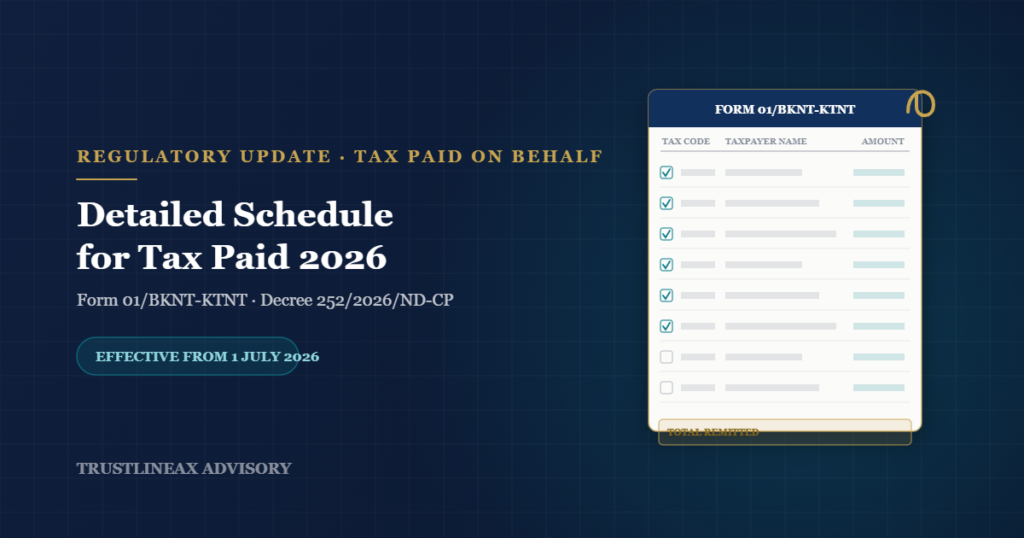
A new regulation that has attracted little attention so far, yet directly affects a large number of businesses and income-paying organizations, is the requirement to submit a detailed schedule of tax amounts paid on behalf of others, using Form 01/BKNT-KTNT, effective from 1 July 2026. This is an entirely new requirement compared with the previous Decree No. 126/2020/ND-CP, set out under Article 60 of Decree No. 252/2026/ND-CP and given concrete form through the template issued under Article 98 of Circular No. 89/2026/TT-BTC. This article, prepared by TrustlineAX, explains who this requirement applies to, when it applies, and what the form must contain.
1. Legal basis
- Decree No. 252/2026/ND-CP (30 June 2026), Article 60 — “Duties, powers and responsibilities of organizations and individuals in providing information on income payments and on tax amounts and other collectible items declared or paid on behalf of others to the tax administration authority.”
- Circular No. 89/2026/TT-BTC (30 June 2026), Article 98 — referencing the specific form set out in Appendix III.
- Form No. 01/BKNT-KTNT — “Detailed Schedule of Tax Amounts Paid on Behalf of Others,” issued together with Circular No. 89/2026/TT-BTC.
- This requirement was also highlighted by the General Department of Taxation as a new point in Official Letter No. 5061/CT-CS dated 22 July 2026.
Both instruments take effect from 1 July 2026.
2. What does the new requirement say?
Under Clause 2, Article 60 of Decree No. 252/2026/ND-CP:
“Organizations and individuals that withhold tax, or declare or pay tax on behalf of others, shall provide detailed information on the tax amounts and other collectible items withheld or paid on behalf of others, using the form prescribed by the Minister of Finance, together with the tax payment document, to the tax administration authority. The deadline for providing this information coincides with the tax payment deadline under tax administration law.”
In short: any organization or individual that withholds tax, or declares or pays tax on behalf of another taxpayer, must, at the time of remitting funds to the state budget, attach a detailed schedule (Form 01/BKNT-KTNT) listing each individual taxpayer whose tax was withheld or paid on their behalf, together with the corresponding amount — rather than simply remitting a single lump-sum payment as was previously the practice.
Why was this requirement introduced?
According to the General Department of Taxation’s explanation in Official Letter No. 5061/CT-CS, this requirement was added to:
- Make things easier for taxpayers when completing procedures relating to tax amounts already withheld or paid on their behalf — such as personal income tax finalization, personal income tax refunds, and confirmation of state budget payment obligations.
- Give the tax authority complete data at the level of each individual taxpayer, addressing the previous situation in which only aggregate figures per filing period were available (with no way to determine how much of a lump-sum payment belonged to which individual), thereby improving transparency and the effectiveness of tax administration.
This is precisely why the requirement matters so much for personal income tax finalization: when an income-paying organization withholds PIT for many individuals and then remits a single lump sum to the state budget, without a detailed schedule the tax authority would struggle to determine exactly how much was withheld for each individual in order to process that person’s finalization or refund.
3. Who must submit Schedule 01/BKNT-KTNT?
The requirement applies to organizations and individuals that withhold tax, or declare or pay tax on behalf of other taxpayers under tax law, for example:
- Income-paying organizations that withhold PIT for employees, or for individuals receiving fees, commissions, and similar payments.
- Organizations that declare or pay tax on behalf of individuals with income from capital investment, securities transfers, or capital transfers.
- Vietnamese parties that withhold and pay tax on behalf of foreign contractors.
- E-commerce platform operators, and organizations that withhold, declare, or pay tax on behalf of business households or individual business owners selling on their platform.
- Insurance agents, lottery agents, multi-level marketing agents, and similar entities where the principal company has withheld tax on behalf of the individual.
4. Deadline for submitting the schedule
Under the regulation, the deadline for providing this information (submitting the schedule) coincides with the tax payment deadline under tax administration law. In other words, there is no separate standalone deadline for the schedule — it must be submitted together with the tax payment document, at the very moment the funds are remitted to the state budget.
5. What must Form 01/BKNT-KTNT contain?
Form 01/BKNT-KTNT, whose full title is “Detailed Schedule of Tax Amounts Paid on Behalf of Others,” is prepared to accompany each state budget payment document, and its main contents are:
General information section:
- [01] Date of submission; [02] Submission number…
- [03] Name of the taxpayer (the withholding/paying-on-behalf party); [04] Tax code
- [05] Return number / Decision number / Notice number / Dossier ID
- [06] Tax period / Decision date / Notice date
- [07] Total amount remitted to the state budget
- [08] Total overpayment carried from the prior period (if any)
- [09] Revenue-managing tax authority
- [10]–[12]: information on the organization or individual providing tax procedure services (if any), their tax code, and the service contract.
Detailed schedule section (by each taxpayer for whom tax was withheld or paid on their behalf), comprising the columns: No., tax code, taxpayer name, amount withheld, description of the state budget payment item (sub-item), amount remitted to the state budget, and overpayment carried from the prior period offset (if any).
Notes printed directly on the form:
- A separate schedule must be prepared for each state budget payment document.
- The total amount remitted to the state budget on the schedule must match the total tax amount on the state budget payment document and equal indicator [07]; the total prior-period overpayment offset (if any) must match indicator [08].
- For individuals whose tax was withheld or paid on their behalf but who have not yet registered for a tax code, tax registration should be completed under Clause 3 of Decree No. 252/2026/ND-CP so that a tax code is available to enter on the schedule.
- The tax authority uses the schedule bearing the most recent submission date and submission number (where the schedule has been adjusted and resubmitted more than once).
6. How this differs from the previous regime
Before 1 July 2026, under Decree No. 126/2020/ND-CP and its implementing guidance, organizations that withheld, declared, or paid tax on behalf of others generally only needed to declare aggregate figures for the tax period on the relevant tax return (for example, the monthly or quarterly PIT withholding return), and were not required to submit a detailed, individual-by-individual schedule together with the payment document each time funds were remitted. This is why the tax authority has confirmed this is an “additional” requirement — entirely new relative to the previous legal framework.
7. What should businesses prepare?
- Review internal processes: each time tax withheld, declared, or paid on behalf of others is remitted to the state budget, the accounting team must simultaneously prepare and submit Schedule 01/BKNT-KTNT to the managing tax authority.
- Ensure the tax code data for each individual whose tax is withheld or paid on their behalf is complete and accurate; for individuals without a tax code, guide them to register in advance so the schedule can be properly completed.
- Reconcile the figures on the schedule against the state budget payment document before submission, to avoid discrepancies between the total on the schedule and the amount actually paid.
- Note that this requirement is directly linked to employees’ year-end PIT finalization and refunds — the more complete and accurate the schedule data, the smoother finalization and refunds will be for each individual later, reducing queries and reconciliation issues.
This article was prepared by TrustlineAX based on Decree No. 252/2026/ND-CP (Article 60), Circular No. 89/2026/TT-BTC (Article 98, Form 01/BKNT-KTNT in Appendix III), and Official Letter No. 5061/CT-CS dated 22 July 2026 from the General Department of Taxation. This content is for general reference only and does not replace the original legal texts or specialized tax advice for individual circumstances.