
Updated: November 2026
Download Decree 399/2026/ND-CP (PDF, Vietnamese)
1. What Decree 399/2026/ND-CP covers
On 2 November 2026, the Government issued Decree No. 399/2026/ND-CP on the minimum wage for employees working under labour contracts. The Decree takes effect on 1 January 2027 and replaces Decree 293/2025/ND-CP of 10 November 2025.
It applies to employees under labour contracts and to employers under the Labour Code, including enterprises (foreign-invested companies included), agencies, organisations, cooperatives, households and individuals who hire workers.
2. Regional minimum wages from 1 January 2027
| Region | Monthly minimum 2026 (Decree 293/2025) |
Monthly minimum 2027 (Decree 399/2026) |
Increase | Hourly minimum 2027 |
|---|---|---|---|---|
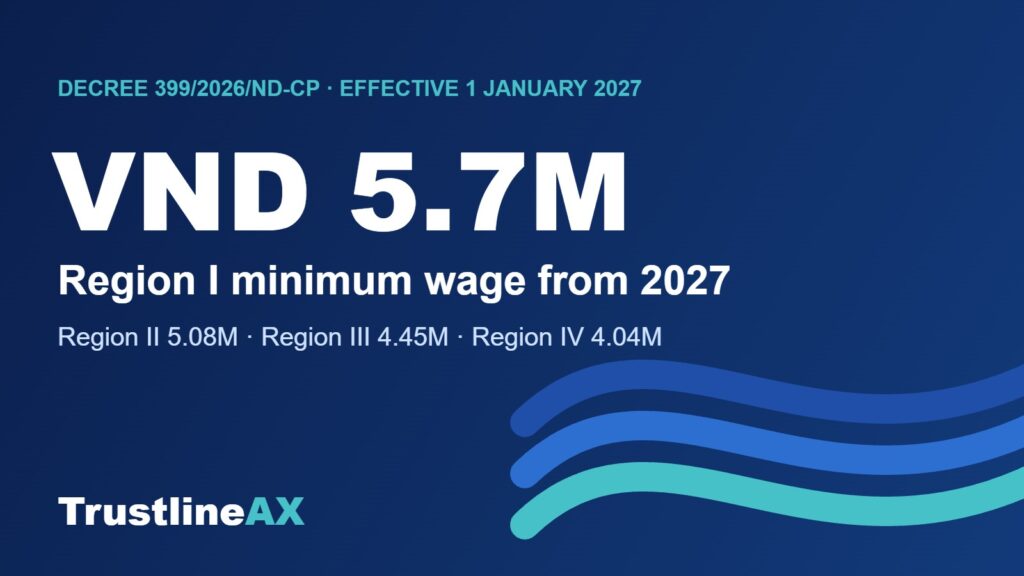
| Region I | VND 5,310,000 | VND 5,700,000 | +VND 390,000 (7.3%) | VND 27,400 (from 25,500) |
| Region II | VND 4,730,000 | VND 5,080,000 | +VND 350,000 (7.4%) | VND 24,400 (from 22,700) |
| Region III | VND 4,140,000 | VND 4,450,000 | +VND 310,000 (7.5%) | VND 21,400 (from 20,000) |
| Region IV | VND 3,700,000 | VND 4,040,000 | +VND 340,000 (9.2%) | VND 19,400 (from 17,800) |
Region IV sees the largest percentage rise (9.2%); the other regions rise by about 7.3–7.5%.
3. Which areas fall into which region
The list of areas is set out in the Appendix to the Decree, by commune and ward after the 2025 administrative reorganisation. Key locations for foreign-invested companies:
| Location | Classification under Decree 399/2026/ND-CP |
|---|---|
| Hanoi | Region I: urban wards and most suburban communes with industrial parks (e.g. Dong Anh, Gia Lam, Soc Son, Me Linh, Quang Minh, Noi Bai, Thach That, Hoa Lac, Thuong Tin, Phu Xuyen). Region II: the remaining communes and wards. |
| Ho Chi Minh City | Region I: urban wards, Thu Duc and many wards and communes of former Binh Duong and Ba Ria – Vung Tau (e.g. Thu Dau Mot, Di An, Thuan An, Ben Cat, Tan Uyen, Vung Tau, Phu My, Ba Ria). Region II: the rest. |
| Hai Phong | Region I: the urban wards of former Hai Phong, most of former Hai Duong and Cat Hai special zone. Region II: the rest. |
| Bac Ninh | Region II: wards and communes with major industrial parks, such as Tu Son, Que Vo, Yen Phong, Tien Du, Thuan Thanh, Viet Yen, Nenh, Van Ha and Bac Giang. Regions III and IV: the remaining communes. |
| Quang Ninh, Dong Nai, Tay Ninh | Include Region I areas (e.g. Ha Long, Quang Yen, Mong Cai; Bien Hoa, Nhon Trach, Long Thanh; Tan An, Duc Hoa, Ben Luc, Can Giuoc) as well as lower regions. |
| Da Nang | Region II: central wards, Hoa Khanh, Lien Chieu, Hoi An, Tam Ky, Dien Ban. Regions III and IV: the remaining communes. |
Companies should look up the exact ward or commune of their head office, branches and factories in the Appendix, rather than relying on former district names.
How the region is determined (Article 3.3):
- An employer applies the minimum wage of the area where it operates.
- Where units or branches operate in areas with different minimum wages, each applies the rate of its own area.
- Employers in industrial parks, export processing zones, hi-tech parks or economic zones that span areas with different rates apply the highest rate.
- Where an area is renamed or divided, the previous rate applies temporarily; where an area is formed from areas with different rates, the highest rate applies, until the Government issues new rules.
4. How the minimum wage applies
- Monthly pay: the job- or title-based wage of an employee who works full normal hours in the month and meets the agreed norms must not be lower than the monthly minimum.
- Hourly pay: the wage for one hour of work meeting the agreed norms must not be lower than the hourly minimum.
- Weekly, daily, piece-rate or lump-sum pay: convert to a monthly or hourly figure for comparison. Weekly pay × 52 ÷ 12 gives the monthly equivalent; daily pay × normal working days in the month does the same.
The comparison is against the job- or title-based wage. Allowances, bonuses and overtime pay cannot be used to “top up” a base wage that is below the minimum.
5. What employers should do before 1 January 2027
- Review wages in labour contracts, salary scales and pay policies. Raise any positions below the new rates, especially unskilled workers, interns on labour contracts and hourly part-time staff.
- Do not cut other entitlements. Article 5.3 prohibits removing or reducing overtime pay, night-work pay, in-kind allowances and other entitlements when adjusting wages.
- Honour more favourable commitments. Where contracts, collective agreements or pay policies already promise at least 7% more for trained workers, or 5% / 7% more for heavy, hazardous or dangerous work, these continue to apply unless the parties agree otherwise.
- Update insurance contribution bases. The salary used for compulsory social insurance must not be lower than the regional minimum wage. The maximum monthly salary for unemployment insurance is 20 times the regional minimum wage, so for Region I it rises from VND 106.2 million to VND 114 million per month from 2027.
- Check every location. A company with its head office in Region I and a factory or branch in Region II (or the reverse) must apply the correct rate at each site.
- Update the 2027 headcount budget and reporting to the parent company: wages, social, health and unemployment insurance and trade union fees all rise with it.
6. Illustrative example
A foreign-invested manufacturer with a factory in a Region I industrial park in Hai Phong pays production workers VND 5,500,000 per month. From 1 January 2027 this is below the Region I minimum (VND 5,700,000), so the company must raise it to at least VND 5,700,000 and pay social insurance on the new wage. If its pay policy commits to paying trained workers 7% above the minimum, the floor for that group becomes VND 6,099,000.
This example is hypothetical and for illustration only.
7. Risk of paying below the minimum wage
Under Decree 283/2026/ND-CP on administrative penalties in labour and social insurance (effective 10 September 2026, replacing Decree 12/2022/ND-CP), an employer that pays below the minimum wage can be fined and required to pay the shortfall plus interest. Social insurance arrears can also be claimed where contributions were made on a wage below the legal floor.
8. Conclusion
Regional minimum wages rise by about 7.3–9.2% from 1 January 2027, with Region I reaching VND 5,700,000 per month. Employers should review contracts, salary scales and insurance bases in November–December 2026 so that January 2027 payroll applies the new rates correctly.
TrustlineAX helps foreign-invested companies review salary scales and run payroll, social insurance and PIT under the new rules. See our payroll services, contact hello@trustlineax.com, call +84 376 375 068 or send us an enquiry.
Disclaimer
This article is based on Decree No. 399/2026/ND-CP of 2 November 2026 and related legislation. 2026 rates are shown for comparison under Decree 293/2025/ND-CP. Companies should check the Appendix to the Decree to confirm the region for each location. This article is for general reference, does not replace the original legal texts and is not advice on any specific case.