
A very common situation in HR and accounting practice: an employee has already resigned and terminated their labor contract, yet the company still needs to pay out certain amounts afterward — the final month’s salary, unused annual leave, a bonus, severance pay, and so on. Are these post-termination payments subject to personal income tax (PIT) withholding, and at what rate? This article, prepared by TrustlineAX based on Decree No. 253/2026/ND-CP (implementing the Law on Personal Income Tax No. 109/2025/QH15) and two practical guidance letters from local tax authorities, clarifies the withholding principle, the applicable rate, which income sources are subject to withholding, and provides worked examples.
1. Legal basis
- Law on Personal Income Tax No. 109/2025/QH15 (10 December 2025), effective from 1 July 2026; provisions relating to business income and to wages/remuneration of resident individuals apply from the 2026 tax period.
- Decree No. 253/2026/ND-CP (30 June 2026) providing detailed implementation of the Law on Personal Income Tax, with Article 50 directly governing tax withholding.
- Circular No. 87/2026/TT-BTC (30 June 2026) providing detailed guidance on certain provisions of the Law and Decree 253/2026/ND-CP.
- Practical application is further illustrated by guidance letters issued by local tax authorities responding to specific queries — for example, Official Letter No. 6661/QNG-QLDN1 dated 6 August 2026 from the Quang Ngai Provincial Tax Department and Official Letter No. 10049/NBI-QLDN1 dated 3 August 2026 from the Ninh Binh Provincial Tax Department, both addressing the exact scenario of paying salary to an employee whose labor contract has already been terminated.
2. General principle: post-termination payments are withheld at a flat 10% rate
Under Clause 2, Article 50 of Decree No. 253/2026/ND-CP, organizations or individuals paying wages, remuneration, fees, or other payments to resident individuals who have no labor contract or a labor contract of under 3 months must withhold tax at a flat rate of 10% of income before payment, where the payment amount is VND 5 million or more per occurrence.
A key point to note: the Decree explicitly states that this 10%-withholding group includes cases of paying wages or other income to an employee whose labor contract has already been terminated. In other words, once a labor contract has ended, any wages or other income paid afterward — even if the employee previously held a contract of 3 months or longer — are handled under the 10% withholding mechanism that applies to individuals without a labor contract, rather than under the progressive tax schedule that applies while an employee is still working under a contract of 3 months or more.
Both practical guidance letters (from the Quang Ngai and Ninh Binh tax authorities) confirm this exact principle: where a company pays an employee’s final month’s salary after the date the labor contract was terminated, that payment is treated as a payment to a person whose labor contract has ended and is handled under Clause 2, Article 50 of Decree 253/2026/ND-CP.
3. Withholding rate and threshold
- Withholding rate: 10% of income, withheld before payment to the individual.
- Mandatory withholding threshold: VND 5,000,000 or more per payment (assessed per payment occurrence, per individual).
- Below VND 5,000,000 per payment: the company is not required to withhold, and withholds 10% only if the individual specifically requests it.
4. Which income sources are subject to withholding, and which are exempt?
4.1. Amounts included in the 10%-withholding tax base
As a general rule, the company withholds 10% on the entire taxable wage and remuneration income paid to the individual after termination of the labor contract — for example, the final month’s salary, bonuses, fees, and other payments of a wage/remuneration nature.
Notably, per tax authority guidance: mandatory insurance contributions, personal/dependent deductions, and other deductions are relevant only when determining taxable income under the progressive tax schedule or at annual finalization, and are not deductible when the company performs the provisional 10% withholding. In other words, the company may not subtract personal/dependent deductions from total income before applying the 10% rate — the 10% must be withheld on the full taxable amount actually paid.
4.2. Amounts excluded (tax-exempt) before calculating withholding
Under Article 26 of Decree No. 253/2026/ND-CP, the following amounts are exempt from PIT and therefore excluded from the income base used to calculate the 10% withholding:
- Wages or remuneration for night work or overtime, to the extent paid in accordance with the conditions and hours prescribed under labor law (the company must maintain a schedule, payroll, timesheet, or labor contract as supporting evidence).
- Wages or remuneration paid for unused annual leave days, within the conditions and limits prescribed under Clause 3, Article 113 of the Labor Code (and applicable law on cadres, civil servants and public employees, where relevant).
- Any portion exceeding the statutory limits for the two items above (excess night/overtime pay, excess unused-leave pay) remains fully taxable as normal and is not exempt.
5. Cases eligible for a commitment to temporarily forgo withholding
Decree 253/2026/ND-CP allows one exception: where an individual’s only income is the type subject to 10% withholding described above, but their estimated total taxable income for the year, after personal/dependent deductions, remains below the tax-liability threshold, the individual may submit a written commitment (in the prescribed form) to the income-paying organization. Based on a valid commitment, the company may temporarily forgo withholding, but remains responsible for compiling and submitting a list of such individuals and their income to the tax authority at year-end. If the individual subsequently earns additional income that creates a tax liability, or if the commitment is found to be fraudulent, the individual bears sole responsibility and is subject to the applicable penalties.
Note: the commitment mechanism applies only where the individual does not yet have a tax code, or otherwise meets the conditions set out in tax administration guidance at the time the commitment is made — companies should carefully verify eligibility before accepting a commitment, to avoid the risk of retrospective tax assessment and penalties.
6. What do local tax authorities say in practice?
To help businesses better picture how this is applied in practice, below are direct excerpts from two official guidance letters issued by local tax authorities addressing this exact scenario — paying salary to an employee whose labor contract has already been terminated.
Official Letter No. 6661/QNG-QLDN1 dated 6 August 2026 from the Quang Ngai Provincial Tax Department, responding to Quang Ngai Urban Environment Joint Stock Company on PIT withholding for income paid after labor contract termination, states:
“Under the personal income tax regulations effective from 1 July 2026, where the Company pays wages, remuneration, fees, or other amounts to an employee whose labor contract has been terminated, and the payment is VND 5 million or more per occurrence, the Company must withhold tax and remit the individual’s withheld tax at a rate of 10% of income before paying the income to the individual.
Where an individual’s only income is of the type subject to the withholding rate stated above, but the individual’s estimated total taxable income after personal/dependent deductions remains below the tax-liability threshold, the individual may submit a commitment to the income-paying organization, which the organization may use as a basis to temporarily forgo withholding personal income tax…”
Official Letter No. 10049/NBI-QLDN1 dated 3 August 2026 from the Ninh Binh Provincial Tax Department, responding to a specific reader query on the same issue, illustrates a scenario very close to what companies commonly encounter:
“On the withholding method for salary paid after termination of a labor contract: where the employee is a resident individual who terminated their labor contract on 30 June 2026, and the Company pays the June 2026 salary on 10 July 2026, this payment falls under the case of paying salary to an employee whose labor contract has been terminated. Where the payment to each individual, per occurrence, is VND 5 million or more, the Company must withhold PIT at 10% before paying the income. Where the payment is below VND 5 million per occurrence, the Company withholds 10% only if the individual requests it.”
This letter further notes on the basis used for withholding:
“The Company withholds 10% on taxable wage and remuneration income before paying the individual… Mandatory insurance contributions, personal/dependent deductions, and other deductions are the basis for determining taxable income when applying the progressive tax schedule or at annual finalization, and are not deducted when performing the provisional 10% withholding…”
Notably, the scenario described in Official Letter 10049/NBI-QLDN1 closely mirrors Example 1 in the calculation section below — this real-world case is in fact the basis TrustlineAX used to construct that worked example.
7. Worked examples
Example 1 — Final month’s salary paid after contract termination, VND 5 million or more:
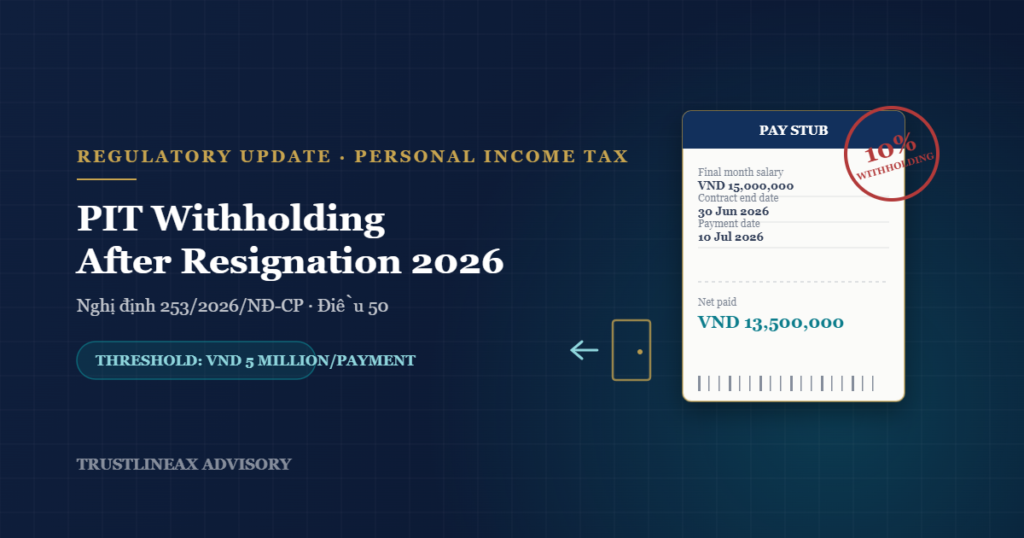
Mr. A, a resident individual, terminated his labor contract with Company X on 30 June 2026. On 10 July 2026, Company X pays the remaining June 2026 salary of VND 15,000,000 to Mr. A (with no night/overtime component).
Because this payment arises after the labor contract has been terminated and is VND 5 million or more, Company X must withhold PIT at 10%:
- Tax to be withheld = VND 15,000,000 × 10% = VND 1,500,000.
- Net amount paid to Mr. A = VND 15,000,000 − VND 1,500,000 = VND 13,500,000.
Example 2 — Including a tax-exempt overtime component:
Ms. B terminates her labor contract with Company Y. The post-termination payment comprises VND 10,000,000 for the final month’s salary and VND 2,000,000 of valid overtime pay (compliant with labor-law conditions and hours, supported by a timesheet).
- The VND 2,000,000 of valid overtime pay is tax-exempt and excluded from the withholding base.
- The income subject to 10% withholding is only the final month’s salary: VND 10,000,000.
- Tax to be withheld = VND 10,000,000 × 10% = VND 1,000,000.
- Total net amount paid to Ms. B = (VND 10,000,000 − VND 1,000,000) + VND 2,000,000 = VND 11,000,000.
Example 3 — Payment below VND 5 million per occurrence:
Mr. C receives a VND 4,000,000 bonus from Company Z after his labor contract has been terminated. Because the payment is below VND 5,000,000 per occurrence, Company Z is not required to withhold tax and withholds 10% only if Mr. C explicitly requests it in writing.
Example 4 — Individual eligible for a commitment to temporarily forgo withholding:
Ms. D’s only income for the year is VND 6,000,000 paid by Company W after termination of her labor contract; her estimated total taxable income for the year, after the personal deduction (currently VND 15.5 million/month for herself), remains below the tax-liability threshold. Ms. D may submit a commitment in the prescribed form to Company W. Based on a valid commitment, Company W temporarily does not withhold the 10% on this VND 6,000,000 payment, but must still include Ms. D in the year-end summary list submitted to the tax authority.
8. Key points for businesses to note
- The 10% withholding described above is only a provisional withholding at source, not the individual’s final PIT liability. At year-end, if subject to annual tax finalization, the individual will aggregate their full-year income, apply personal/dependent deductions and other deductions, and recalculate tax under the progressive schedule (where applicable) or the relevant finalization rules; the 10% already withheld is credited against the final tax payable, with any excess refunded or offset.
- Companies should clearly distinguish the timing of the withholding obligation: if a payment arises before contract termination and the employee still holds a contract of 3 months or more, that payment continues to be withheld under the ordinary progressive schedule; only payments made after the contract has been terminated are subject to the 10% withholding under Clause 2, Article 50.
- Companies should retain complete supporting documentation (contract termination decision, payroll records, overtime/night-work timesheets, the individual’s commitment form if applicable, etc.) to substantiate the withholding treatment if requested by the tax authority.
- Where a specific practical issue arises, many companies submit an official letter to their managing tax authority requesting written guidance (as in the Quang Ngai and Ninh Binh examples above) — a recommended approach whenever a situation has unusual features, to avoid an incorrect application that could later lead to retrospective tax assessment and penalties.
This article was prepared by TrustlineAX based on the Law on Personal Income Tax No. 109/2025/QH15, Decree No. 253/2026/ND-CP (Articles 26 and 50), Circular No. 87/2026/TT-BTC, and practical guidance from Official Letter No. 6661/QNG-QLDN1 (Quang Ngai Provincial Tax Department) and Official Letter No. 10049/NBI-QLDN1 (Ninh Binh Provincial Tax Department). The worked examples illustrate general principles only and do not replace the original legal texts or specialized tax advice for individual circumstances; businesses should verify against actual records and consult their managing tax authority where questions arise.