
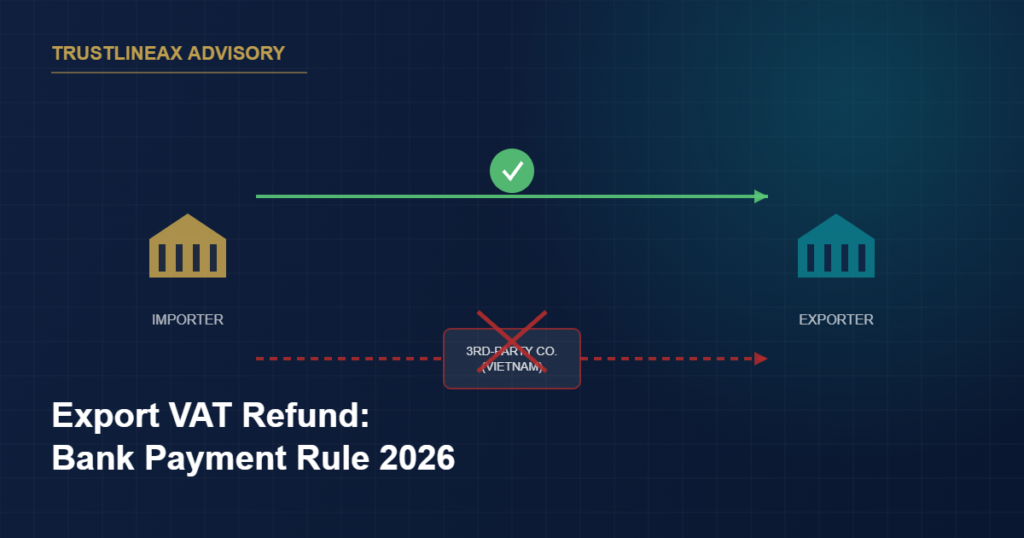
Businesses exporting goods or services need to pay particular attention to the payment flow, since this is one of the mandatory conditions for input VAT deduction and refund. Official Letter No. 3251/CT-CS dated 21 May 2026 of the General Department of Taxation (GDT) (responding to the Da Nang Tax Department) restates and clarifies a situation that commonly arises in practice: where the exporter does not receive payment directly from the overseas importer, but instead receives it through another company in Vietnam. Trustlineax summarizes the official letter for exporters to review their own payment flows.
1. Legal basis
- Official Letter No. 3251/CT-CS dated 21 May 2026 of the GDT, responding to Official Letter No. 878/DAN-KTr1 dated 4 March 2026 of the Da Nang Tax Department.
- Clause 3, Article 16 of Circular No. 219/2013/TT-BTC dated 31 December 2013 of the Ministry of Finance — sets out the conditions for input VAT deduction and refund on exported goods and services, including the bank-payment condition.
- Article 14 of Law on VAT No. 48/2024/QH15 and Article 26 of Decree No. 181/2025/ND-CP — the rules currently in force on non-cash payment documentation, applicable from 1 July 2025.
Note on the legal framework: Circular No. 219/2013/TT-BTC is the instrument cited by Official Letter No. 3251/CT-CS in answering this specific case. From 1 July 2025, the conditions for VAT credit and refund moved to Law on VAT No. 48/2024/QH15 and Decree No. 181/2025/ND-CP. The principle set out in this article is unchanged — payment must flow from the foreign buyer’s account to the Vietnamese seller’s account — but businesses should check against the current instruments for transactions arising from 1 July 2025 onwards.
2. What counts as a valid “bank payment”?
According to the GDT, a bank payment for exported goods is defined as a transfer of funds from the importer’s account to an account in the exporter’s own name at a bank, made in a form consistent with the contract and the bank’s regulations. The valid payment document is a credit advice (giấy báo Có) issued by the exporter’s bank confirming the amount received from the importer’s bank account.
Where the overseas party (the importer) pays directly to an authorized export agent (a party other than the one that directly signed the contract and carried out the export procedures), the authorized export agent must hold bank-payment documentation, and this payment arrangement must be clearly stated in the contract.
3. The disqualifying scenario: receiving payment through another company in Vietnam
This is the key point the GDT makes clear in the letter: where the exporter does not receive payment directly from the overseas importer, but instead receives it from another company in Vietnam (i.e. a company that does not itself export but nonetheless receives the export proceeds), this does not satisfy the bank-payment condition required for input VAT deduction and refund on the exported goods or services.
In other words, the payment flow must run directly from the overseas importer’s account (or a party properly authorized to pay under the contract) to an account in the exporter’s own name. If the export proceeds are instead received by an intermediate entity in Vietnam (one that is neither the exporter nor a properly authorized export agent under the contract) and then passed on to the exporter, the transaction will not be treated as a valid “bank payment” under the regulations — creating a risk that the corresponding input VAT will be disallowed for deduction or refund.
4. How is the GDT handling this?
The GDT has asked the Da Nang Tax Department to rely on VAT law, related regulations, and the actual case file to determine the exporting entity in the transaction, and to cross-check the bank-payment documentation accordingly before deciding within its authority. The letter therefore does not reach a conclusion for a specific case, but sets out a general principle for the local tax authority to apply when reviewing a business’s refund file.
5. What should exporters pay attention to?
- Review the export contract and the actual payment flow: does the party named as recipient on the bank’s credit advice actually match the exporter (or a properly authorized export agent)?
- If a third party in Vietnam receives export proceeds on the exporter’s behalf and then passes them on, review the transaction structure and contracts to ensure the funds flow correctly from the overseas importer to the exporter (or to an export agent clearly designated in the contract).
- For transactions involving an authorized export agent, ensure the agency contract clearly states that the overseas party pays the agent directly, and that the agent retains full bank-payment documentation.
- Where the current payment model involves receiving funds through a domestic third party, proactively review this before filing a refund claim, to avoid having the corresponding input VAT disallowed when the tax authority cross-checks payment documents.
6. How this relates to the VND 5 million non-cash payment threshold
The bank payment condition discussed here applies to exported goods and services — money flowing from a foreign customer into Vietnam. It should not be confused with a separate condition: the non-cash payment threshold on purchases.
From 1 July 2025 that threshold fell from VND 20 million to VND 5 million, VAT inclusive, and applies to imports as well, under Article 14 of Law on VAT No. 48/2024/QH15 and Article 26 of Decree No. 181/2025/ND-CP.
Exporters are affected by both: on the output side, proving payment came through a bank from the correct party; on the input side, holding non-cash payment documents for every cost from VND 5 million upward. A failure on either side affects the refundable amount.
For an overview of the current VAT framework, see the VAT guide for FDI companies.
This article was compiled by Trustlineax based on Official Letter No. 3251/CT-CS dated 21 May 2026 of the General Department of Taxation and clause 3, Article 16 of Circular No. 219/2013/TT-BTC. The content is for reference only and does not replace the original legal text or professional tax advice for a specific transaction or case file.