
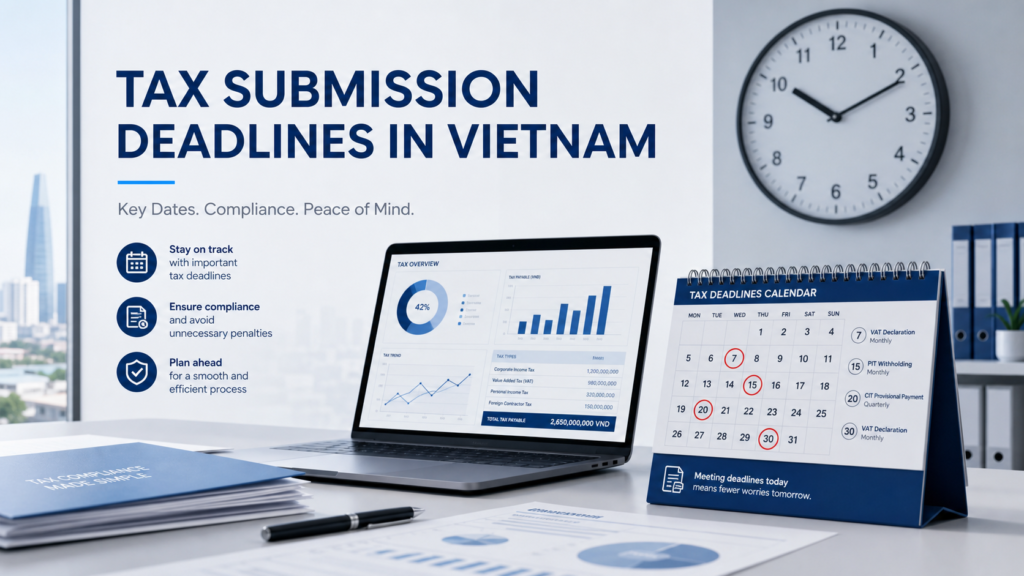
For foreign-invested enterprises (FIEs) in Vietnam, tax compliance is not a once-a-year task — it is a continuous cycle of monthly filings, quarterly payments, and annual finalizations, all governed by rules that changed significantly in 2025 and 2026. Missing a deadline or misapplying a new regulation can trigger penalties, interest, and audit exposure. This guide explains what tax compliance in Vietnam involves today, the key 2026 changes foreign companies must act on, and how a professional partner reduces your risk.
What tax compliance in Vietnam covers
A complete tax compliance service for an FDI company handles every recurring obligation, including value-added tax (VAT), corporate income tax (CIT), personal income tax (PIT) withheld from employees, and foreign contractor tax (FCT). In practice this means preparing and submitting declarations on time, calculating liabilities accurately, maintaining e-invoices, and keeping documentation ready for inspection.
The core filing rhythm in Vietnam looks like this:
- VAT — filed monthly (by the 20th of the following month) or quarterly (by the last day of the first month of the next quarter), depending on your revenue and registration.
- PIT and FCT — declared monthly or per payment, with monthly filings generally due by the 20th.
- CIT — paid provisionally each quarter, with annual finalization due within 90 days of the fiscal year-end.
- Transfer pricing documentation — prepared before CIT finalization and provided to authorities on request.
A critical point for foreign investors: for PIT and FCT, the Vietnamese entity carries full compliance liability. Errors made on behalf of employees or foreign contractors still fall on your company.
What changed in 2025 to 2026
Vietnam entered a staged tax reform cycle, and several updates directly affect FDI companies in 2026:
The new VAT Law (Law 48/2024) took effect from July 2025, with certain provisions applying from January 2026. The standard VAT rate remains 10%, with 5% and 0% continuing for priority sectors. A new VAT refund mechanism benefits foreign investors in encouraged sectors such as high-tech, semiconductors, renewable energy, and R&D.
The new CIT Law (Law 67/2025) keeps the standard rate at 20%, but large multinational groups now face a 15% effective floor under the Global Minimum Tax rules, applicable from fiscal year 2024. Groups within scope must model their potential top-up liability carefully.
A revised PIT Law (Law 109/2025) restructures personal income tax brackets, with key provisions taking effect across 2026 — meaning payroll tables need updating.
Two procedural changes matter for every FIE: paper-based tax filings are no longer accepted for FDI enterprises from March 2026, so fully digital filing is now mandatory; and the tax authority has introduced an AI-supported, risk-based audit scoring system, raising the importance of clean, consistent records.
The most common compliance risks
Penalties in Vietnam follow Decree 125/2020 for late or incorrect filing, while late payment interest accrues at roughly 0.03% per day. The most frequent triggers we see for foreign companies are missed monthly deadlines during busy periods, inconsistent e-invoicing, and weak transfer pricing documentation — which remains the leading cause of tax audits. A capital transfer exit now also carries a 2% tax on gross proceeds, so restructuring before a disposal can preserve returns.
Why outsource tax compliance
Keeping pace with this volume of change in-house is difficult and expensive. Outsourcing your tax compliance gives you a team that tracks every regulatory update, files accurately and on time through Vietnam’s electronic systems, and represents you directly if the tax authority opens an inspection. It converts a high-risk internal burden into a predictable, managed service.
How TrustlineAX helps
At TrustlineAX Advisory, we manage the full tax compliance cycle for foreign-invested companies — VAT, CIT, PIT, and FCT declarations, annual finalization, transfer pricing support, VAT refund claims, and direct representation during tax audits. We keep their filings aligned with the latest 2026 rules so they never face avoidable penalties.
Want to make sure your Vietnam tax filings are fully compliant in 2026? Contact us for a free 30-minute consultation.