
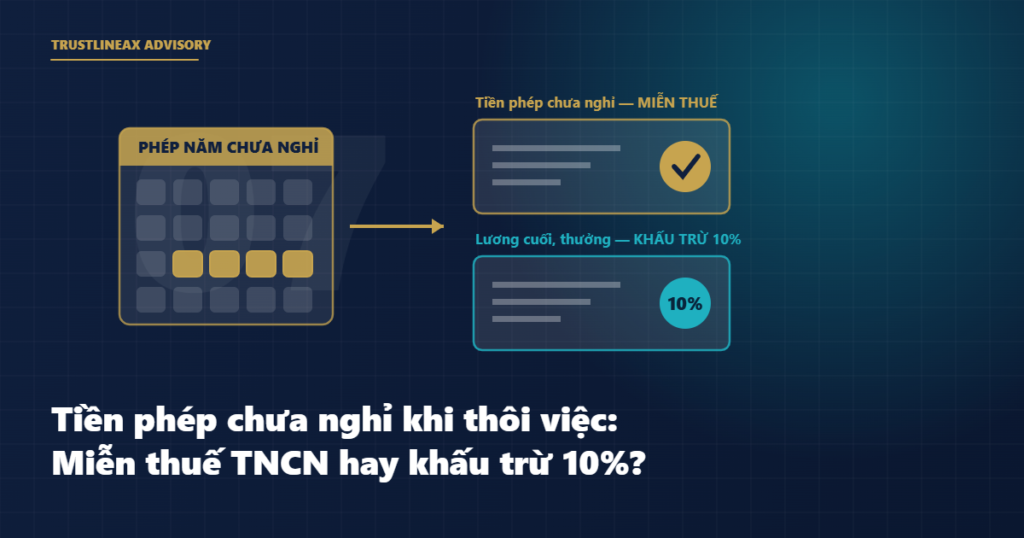
When an employee leaves the company without having used up their annual leave, the employer must pay them for the untaken days. The question accountants keep running into is this: does that payment count as taxable personal income, and must it be subject to the same 10% withholding applied to other amounts paid after the labour contract ends? A company in Dong Nai put exactly that question to the tax authority, and received an answer in Official Letter No. 15676/DON-QLDN1 dated 14 August 2026 issued by the Dong Nai City Tax Department. This article, prepared by Trustlineax on the basis of that letter together with Decree No. 253/2026/ND-CP, sets out the difference between two payments that are easily lumped together on an employee’s final payslip: pay for untaken annual leave (potentially PIT-exempt) and other income paid after contract termination (subject to 10% withholding).
1. Legal basis
- Labour Code No. 45/2019/QH14, Article 113.3 — payment of wages for untaken annual leave upon resignation or job loss.
- Law on Personal Income Tax No. 109/2025/QH15, Article 3.2 (taxable income) and Article 8.3 (timing for determining assessable income from wages and salaries).
- Decree No. 253/2026/ND-CP (30 June 2026), effective 1 July 2026 and applicable from the 2026 tax period for employment income — Articles 6 and 8 (taxable income, employment income), Article 26 (exemption for night-shift pay, overtime pay and pay for untaken leave) and Article 50 (tax withholding).
- Official Letter No. 15676/DON-QLDN1 dated 14 August 2026 from the Dong Nai City Tax Department, responding to a company’s query on applying PIT policy under Decree 253/2026/ND-CP.
2. Background: one practical question, two payments that get merged
In practice, a departing employee’s final settlement usually bundles several items together: the last month’s salary, any outstanding bonus, and pay for untaken annual leave. Because all of them fall due after the labour contract has ended, it is easy for payroll staff to apply a single tax treatment to the lot — typically withholding 10% across the whole amount. Official Letter 15676/DON-QLDN1 makes clear that these are two categories of income with different natures and different tax treatments, and they must be separated.
3. The rule: pay for untaken annual leave on termination
Article 113.3 of Labour Code No. 45/2019/QH14 provides:
“Where an employee resigns or loses their job without having taken annual leave, or without having used up their annual leave entitlement, the employer shall pay wages for the untaken days.”
This is a statutory obligation of the employer under labour law, not a discretionary benefit. The number of untaken days and the wage rate applied are determined by reference to the labour contract, the payroll and the individual leave record for each employee.
4. Pay for untaken leave: PIT-exempt within the statutory limit
This is the point the official letter clarifies. Under Article 26.2 of Decree No. 253/2026/ND-CP:
“2. Personal income tax shall be exempt on wages and salaries paid for untaken leave days, consistent with the conditions and the level of wages and salaries payable for untaken leave days prescribed in Article 113.3 of the Labour Code and in the Law on Cadres and Civil Servants and the Law on Public Employees.”
In other words: where the payment for untaken leave matches the conditions and the rate prescribed by Article 113.3 of the Labour Code, that amount is exempt from PIT — the same treatment given to night-shift and overtime premiums under Article 26.1.
Article 26.3 of Decree 253/2026/ND-CP, however, sets the boundary of that exemption:
“3. Where wages and salaries for night work, overtime, or wages and salaries paid for untaken leave days exceed the level prescribed by law, the excess portion shall be included in the individual’s taxable income.”
The exemption therefore applies only up to the level labour law allows. If the company pays more than the amount determined under Article 113 of the Labour Code — for example by applying a daily rate higher than the actual wage base, or by paying out more days than may validly be carried forward — the excess remains taxable income for the employee in the ordinary way.
5. Distinguishing this from the 10% withholding on termination payments
This is where the confusion arises. Pay for untaken leave (within the exempt level) is a PIT-exempt amount under Article 26. Other income — final-month salary, bonuses, and any payment not falling within an exemption — paid to an employee after the labour contract has already ended falls under an entirely separate provision, Article 50.2 of Decree 253/2026/ND-CP:
“2. Organisations and individuals paying wages, salaries, remuneration or other amounts to a resident individual with no contract, or with a labour contract of under three months (including payments of wages and other income to an employee whose labour contract has terminated), where the payment is VND 5 million or more per occasion, must withhold tax and remit the withheld amount at the rate of 10% of the income before paying the individual. Where the payment is under VND 5 million per occasion, the payer may withhold at 10% if the individual so requests.”
Official Letter 15676/DON-QLDN1 restates this principle: wages and other income paid to an employee whose contract has terminated, where the payment is VND 5 million or more per occasion, must be subject to 10% withholding on total taxable income before payment — taxable income being determined under Article 3.2 of PIT Law 109/2025/QH15 as detailed in Articles 6 and 8 of Decree 253/2026/ND-CP. We analysed this withholding mechanism in detail in 10% PIT withholding on payments after employment ends.
Because pay for untaken leave (within the limit) is exempt, it does not form part of “taxable income” — and therefore sits outside the base on which the 10% is withheld. Employers must separate this amount from the other taxable payments when calculating the withholding.
6. Worked example
Mr A’s labour contract terminates on 31 July 2026. He has 4 days of untaken annual leave, and the wage base used for the leave payment, calculated in accordance with the rules, is VND 800,000 per day. On 10 August 2026 the company pays him:
- Pay for untaken annual leave: 4 days × VND 800,000 = VND 3,200,000. This matches the level prescribed by Article 113.3 of the Labour Code → PIT-exempt. The company pays the full VND 3,200,000 with no withholding.
- July salary (final month) and outstanding bonus: VND 12,000,000. This is a payment to an employee whose labour contract has terminated, at VND 5 million or more per occasion → 10% withholding applies: VND 12,000,000 × 10% = VND 1,200,000. The net paid on this item is VND 10,800,000.
Total actually paid to Mr A = 3,200,000 + 10,800,000 = VND 14,000,000, with the company withholding and remitting VND 1,200,000 of PIT on his behalf (calculated on the final salary and bonus only, not on the leave payment).
Note: if the company had rolled the VND 3,200,000 leave payment into total income and withheld 10% on the full VND 15,200,000, it would have over-withheld by VND 320,000 — the common error that follows from not separating the two categories.
7. Supporting documents to keep
Decree 253/2026/ND-CP does not require a separate schedule for pay for untaken annual leave (unlike night-shift and overtime pay under Article 26.1, where a schedule is mandatory). Even so, to demonstrate that the payment is “consistent with the conditions and the level of wages and salaries” under Article 113.3 of the Labour Code if the tax authority asks, the company should retain:
- The termination decision or notice, showing the last working day.
- The leave record showing days taken and days remaining as at the termination date.
- The basis for the daily wage rate used for the leave payment (labour contract, payroll).
- Payment records that show the leave payment separately from other taxable items (final salary, bonus), so the figures can be reconciled at annual finalisation or on a tax audit.
8. A further point from the letter: overtime-hour queries are outside the tax authority’s remit
Official Letter 15676/DON-QLDN1 makes one further point worth noting: where a company has a query about the rules on overtime hours — for example statutory caps on maximum overtime — that matter falls outside the duties and powers of the tax administration under Article 38 of Law on Tax Administration No. 108/2025/QH15. Companies should direct such questions to the competent state labour authority rather than to the tax office.
9. What companies should do
- When settling final pay for a departing employee, separate the untaken annual leave payment from other taxable income on the payslip and payment records, instead of merging everything and withholding 10% on the total.
- Check that the wage rate used for untaken leave follows the labour contract and Article 113 of the Labour Code; any amount paid above that level is taxable income and is not exempt.
- For other income paid after contract termination (final-month salary, bonus, etc.) of VND 5 million or more per occasion, apply the 10% withholding under Article 50.2 of Decree 253/2026/ND-CP.
- Retain complete supporting documents — termination decision, leave record, wage-rate calculation, and payment records showing each item separately — for use in a tax audit or in the employee’s year-end finalisation.
- For a specific issue, submit a written query to your managing tax office; for labour-law issues (overtime hours, leave conditions), address the state labour authority instead, as these fall outside the tax authority’s jurisdiction.
See also: Vietnam payroll guide 2026 and Personal income tax for expatriates in Vietnam 2026. TrustlineAX provides payroll and labour compliance services for FDI companies.
This article was prepared by Trustlineax on the basis of Labour Code No. 45/2019/QH14 (Article 113), Law on Personal Income Tax No. 109/2025/QH15, Decree No. 253/2026/ND-CP (Articles 6, 8, 26 and 50) and Official Letter No. 15676/DON-QLDN1 dated 14 August 2026 from the Dong Nai City Tax Department. The worked example illustrates general principles and does not replace the source legislation or tax advice tailored to a specific case.